DIY Supplies North East have migrated to Greenwood Building Supplies Limited – View our new website at https://greenwoodbuildingsupplies.com/
DIY Supplies North East have migrated to Greenwood Building Supplies Limited – View our new website at https://greenwoodbuildingsupplies.com/
When you shop with us, you can rest assured that all our prices already include the value-added tax (VAT). This means that the final cost you see is the total amount you’ll need to pay, with no hidden taxes or additional charges. We believe in transparent pricing, so you can make informed decisions and budget accordingly.
However, if you are a VAT-registered business, we can provide you with a separate VAT invoice after your purchase. All you need to do is let us know that you’re a VAT-registered entity, and we’ll be happy to issue the appropriate documentation. This will allow you to claim the VAT back on your business expenses, ensuring that you’re getting the most out of your purchase.
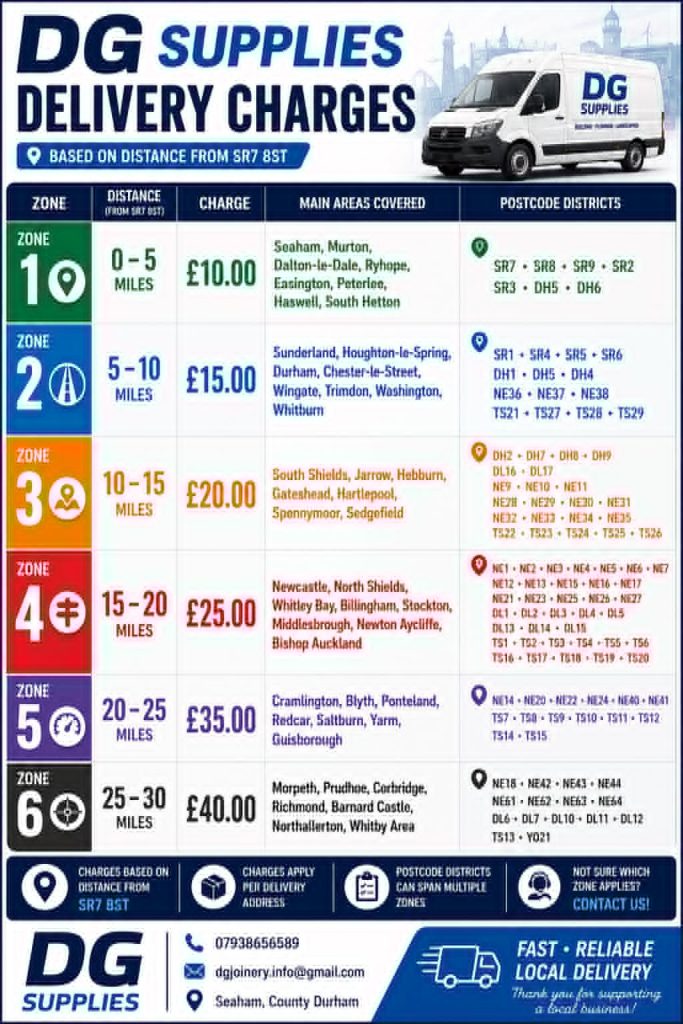
Delivering across the UK is a core part of our service offering, but the cost can vary depending on the location. We charge per radius, which means that orders placed within the North East region tend to be more affordable for our customers. This is due to the efficiency of our logistics and the proximity of our distribution centers to these areas.
In fact, the majority of our orders are fulfilled and sent out the very same day, thanks to the fleet of delivery vans we operate in-house. This allows us to provide a reliable and timely service, even for customers located further afield. By maintaining control over the entire delivery process, we can ensure a seamless experience from order to arrival.
We may run exclusive promotions on our website that are not available in-store, and vice versa. That’s why it’s important to always check our website or with our staff before picking up an order in-store.
We want to provide our customers with the most seamless and rewarding shopping experience, which is why we encourage you to double-check the availability of any promotions before completing your order.
It’s important to note that all direct deliveries require a signature upon receipt. We are unable to leave your order at your address if you are not home. If we attempt to deliver and you are not available, we will contact you to inform you that we have arrived. If you are unable to collect the order, an additional redelivery fee may apply. This fee covers the cost of the petrol and staff time required to make the second delivery attempt. By understanding and adhering to these policies, you can ensure a smooth and efficient delivery process, and avoid any unexpected charges.
As a trade customer, you have the opportunity to access our exclusive pricing that is not available to the general public. By calling us, you can obtain a unique access code that will unlock these special rates reserved solely for our valued trade partners.
When you call, our team will be ready to guide you through the simple process of obtaining your access code, ensuring you can immediately start taking advantage of the significant savings. Don’t miss out on this chance to maximise your profitability.
When shopping for screws on our website, you can rest assured that you’ll find the perfect size to fit your project. Our selection allows you to choose the exact length needed, taking the guesswork out of the equation. We recommend selecting a screw that is approximately 5mm (1/4″) longer than the panel it will be going through. This simple rule of thumb ensures a secure, stable hold without the risk of the screw protruding too far.
If you’re ever unsure about which size screws to choose, our team of experts is here to help. Simply reach out to us, and we’ll provide personalised guidance to make sure you select the right screws for your specific needs.
We are open to discussing custom hardware projects with our trade customers, but there are certain order volume thresholds that must be met. If you are interested in exploring a custom hardware solution, your best course of action is to create a trade account with us. This will allow us to better understand your specific needs and requirements, and work closely with you to develop a tailored hardware solution that meets your business needs.
As a customer, you may be tempted to checkout as a guest. However, creating an account provides valuable benefits. An account allows you to easily update personal/business details, check order status, reorder, and manage preferences. The time-saving and organisational advantages of an account make the registration process worthwhile. We encourage you to consider the compelling benefits of becoming a registered customer.
Let’s face it: with the cost of living on the rise, hiring professionals for every little home project can feel like throwing money down the drain. DIY (do-it-yourself) has become not just a trend, but a smart, budget-friendly approach to home improvement. Whether it’s fixing that leaky faucet or repainting your living room, taking matters into your own hands can save you a pretty penny.
Think about it—when you tackle projects yourself, you’re cutting out labor costs and often just paying for materials. Plus, there’s something incredibly satisfying about seeing your hard work pay off. You get to learn new skills along the way and truly personalize your space without breaking the bank.
Of course, there are some projects that might be best left to the pros (we all know our limits), but for many homeowners looking to stretch their dollars further, DIY is definitely an appealing option. So grab those tools and get creative—your wallet will thank you!
So, you’re ready to dive into the world of DIY? Awesome! The key is to start small. Your initial projects should be relatively simple and not too time-consuming. Think about tasks like repainting a room—nothing feels better than a fresh coat of paint to brighten up your space. Or how about installing new cabinet hardware? It’s a quick fix that can completely transform your kitchen or bathroom without breaking the bank.
If you’re feeling a bit more adventurous, creating custom shelving can be both practical and stylish. Plus, it gives you that instant gratification of seeing something you built with your own hands! The idea here is to build that confidence with smaller projects before moving on to bigger challenges. Trust me, once you see what you can accomplish, you’ll be itching to tackle even more ambitious DIY endeavors!
If you’ve decided it’s time to replace an old or outdated internal door, you may be able to save some time and money by fitting it yourself. Hanging an interior door needn’t be as daunting as you might think. Sure, it might feel a bit intimidating at first, but with the right tools and our handy step-by-step guide, you can get the job done right.
First things first: gather your tools. You’ll need a tape measure, a level, a screwdriver, and possibly a chisel if you’re working with hinges that require mortising. Once you have everything ready to go, measure your new door against the frame to ensure it fits perfectly. If everything checks out, it’s time to hang!
Start by attaching the hinges to the door before positioning it in the frame. This is where having a second pair of hands can be super helpful—holding the door while you screw in those hinges makes life so much easier! Once it’s hung up, check for level and make any necessary adjustments.
With patience and attention to detail, fitting an internal door yourself can be a manageable and rewarding DIY project that enhances your home. Plus, there’s nothing quite like stepping back and admiring your handiwork once it’s all finished! So roll up those sleeves—you’ve got this!
Cutting wood veneer panels might seem like a daunting task, but it’s pretty straightforward once you get the hang of it. First things first, make sure your veneer is sized correctly. Once you’ve got that sorted, grab a utility knife and let’s get to work!
Before you start cutting, take a moment to check the blade. A sharp blade is crucial here—if it’s dull, you risk damaging and marking the beautiful surface of your veneer. Trust me; you don’t want that!
Now, carefully score the back of the material along your marked line. It usually takes a few passes with the blade to cut through cleanly. Just keep running the knife along that line until you feel it give way—when done right, you’ll end up with a nice clean cut that makes all your hard work worth it! It’s all about patience and precision; soon enough, you’ll be cutting veneer like a pro!
When it comes to woodworking projects, a common debate arises: are wooden dowels better than screws? Honestly, it often boils down to what you’re building and how you want it to hold up over time.
Due to their sturdiness, dowel connectors are ideal for woodworking projects like building furniture or cabinets. They create a strong joint that can handle heavier loads without the risk of loosening over time. Unlike screws, which might eventually fail or come loose with wear and tear, dowels provide a much more reliable connection.
Sure, screws can be convenient and quick for assembly, but if you’re aiming for durability and longevity in your project, dowels have the upper hand. They not only offer that solid feel but also keep your work looking clean since they don’t leave visible holes like screws do. So next time you’re deciding between the two for your next DIY project, consider going with dowels for a sturdier finish!
When it comes to the strongest wood in the UK, ash is often at the top of the list. This sturdy hardwood is not just tough; it’s also incredibly versatile. Ash wood has a fantastic strength-to-weight ratio, making it perfect for everything from furniture to sports equipment.
One of the coolest things about ash is its flexibility. It can bend without breaking, which is why you’ll find it used in items like baseball bats and even some types of tool handles. Plus, its light color and beautiful grain make it a favorite among woodworkers and designers alike.
If you’re considering a project that requires strength and durability, ash should definitely be on your radar! Whether you’re crafting something functional or purely aesthetic, this wood offers both resilience and beauty that few others can match.
When it comes to budget-friendly wood options for your home furniture projects, a few stand out as the go-to choices. First up is pine, which is not only widely available but also incredibly easy to work with. Sure, it’s softer than hardwoods, so you might want to be a bit gentle with it if you’re planning on heavy use. But for things like shelves or simple tables, pine does the job beautifully and won’t break the bank.
Then there’s plywood, which deserves a shout-out for its strength and stability. Thanks to its layered construction, plywood can handle some serious weight without warping or bending—making it perfect for structural components in your projects. And let’s not forget about MDF (medium-density fiberboard), another affordable option that offers a smooth surface for painting or veneering.
So whether you’re crafting a cozy coffee table or building sturdy bookshelves, pine, plywood, and MDF are fantastic choices that keep your wallet happy while still delivering solid results!
When it comes to building a wood fence, one of the burning questions is whether to nail or screw it together. Honestly, both methods have their pros and cons, but let’s break it down a bit.
First off, if you’re thinking long-term, consider the care your fence will need over time. Anticipating potential repairs is key. Screws offer a fantastic advantage here; they make removal easy when it’s time for maintenance or replacements. You can simply unscrew a panel without damaging the surrounding wood—pretty neat, right?
On the flip side, nails provide that solid initial hold that can feel reassuring. However, when you need to extract them for repairs or adjustments down the line, be prepared for some wrestling matches with those stubborn little things! Nails can be tricky to pull out cleanly without causing damage.
So ultimately, if you value ease of maintenance and anticipate needing to replace parts in the future, screws might just be your best bet. But if you’re looking for that immediate steadfastness and don’t mind a little extra work later on, nails could do the trick too! It’s all about what works best for your situation and how much hassle you’re willing to take on down the road.
WhatsApp us